 Skip to content
SEO vs. GEO vs. AEO: The Ultimate Guide to Dominating Search in 2026
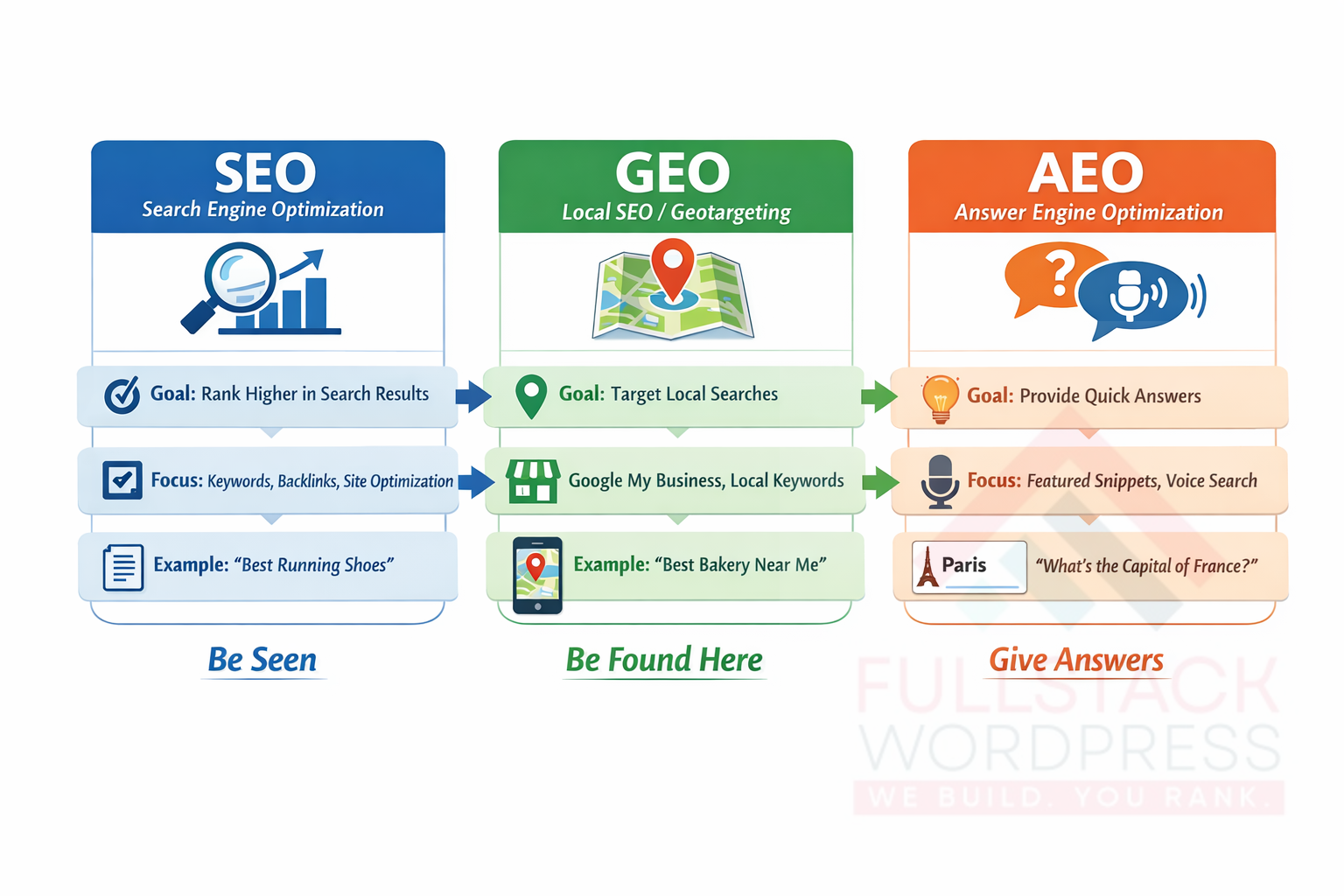
Search is changing faster than ever in late 2025—Google’s AI Overviews are everywhere, ChatGPT gets billions of queries, and users want instant answers, not just links. Traditional SEO isn’t dead, but it’s not enough anymore. Enter Generative Engine Optimization (GEO) and Answer Engine Optimization (AEO)—the new kids on the block that can make your content the go-to source in AI responses.
We have helped hundreds of sites adapt to algorithm shifts, and right now, ignoring GEO and AEO means losing visibility to competitors who show up in AI citations and zero-click answers.
In this guide, we’ll break down the differences, why they matter, and actionable strategies to optimize for all three. Master this, and you’ll future-proof your traffic in 2026.
What Are SEO, AEO, and GEO? Quick Breakdown
- SEO (Search Engine Optimization): The classic—optimizing for rankings in traditional results (blue links) to drive clicks. Focus: Keywords, backlinks, speed, E-E-A-T.
- AEO (Answer Engine Optimization): Targets direct answers in featured snippets, voice search, and AI overviews. It’s about being the concise, authoritative response to questions.
- GEO (Generative Engine Optimization): Optimizes for full AI-generated responses in tools like ChatGPT, Perplexity, or Gemini. Goal: Get cited or summarized in conversational, synthesized answers.
Many experts treat AEO and GEO as overlapping or evolving SEO—it’s not “vs.” but “and.” Strong SEO foundations boost all three, but AI demands more structure and authority.
| Aspect | SEO | GEO / Local SEO | AEO |
|---|---|---|---|
| Goal | Rank higher in general search | Rank for local searches | Provide direct answers |
| Focus | Keywords, backlinks, content | Location-specific content | Structured content, snippets |
| Users | General/global | Local | Searchers wanting quick answers |
| Tools | Ahrefs, SEMrush, Yoast | Google My Business, Maps | Schema markup, FAQs, structured data |
| Outcome | More traffic | More local traffic & visits | Featured snippets, voice search results |
Why GEO and AEO Matter More in 2026
AI referrals surged 357% year-over-year, while traditional clicks dropped. Zero-click searches are rising—users get answers without visiting sites. If you’re not cited in AI, you’re invisible.
Benefits: Higher brand awareness (even in zero-click), referral traffic from citations, and authority building. I’ve seen clients gain 20-50% more impressions by layering GEO/AEO on SEO.
Key Strategies to Optimize for SEO + AEO + GEO
The good news? Tactics overlap heavily. Focus here for maximum impact:
- Build E-E-A-T on Steroids: Demonstrate Experience, Expertise, Authoritativeness, Trustworthiness. Add author bios, citations, stats, unique insights. AI loves trustworthy sources.
- Structure Content for Machines: Use headings, lists, tables, short paragraphs. Answer questions directly. Implement schema markup (FAQ, HowTo, Article) for easy parsing.
- Write Conversationally: Natural language wins in generative AI. Use questions in headings, bullet points for steps.
- Refresh and Update Content: AI favors fresh info. Audit old posts regularly.
- Technical Wins: Fast sites, mobile-first, structured data. Add llms.txt for AI crawlers.
- Off-Site Authority: Get mentioned in forums, Reddit, trusted publications. Brand consistency across platforms builds consensus for AI trust.
- WordPress-Specific Tips: Use plugins like Rank Math, AIOSEO, or GEO-specific ones (AI Generative Search Optimizer, GEO for AI Lite). They automate schema and audits.
Measuring Success in the AI Era
Track with Google Search Console (AI Overview impressions), tools like Profound or Semrush for citations, and referrals from AI sources.
Integrate All Three Now
2026 search is AI-first. SEO gets you indexed; AEO/GEO gets you answered and cited. Start with a content audit—add schema to top pages, refresh for freshness, and build authority.
I’ve turned sites around by embracing these shifts early. You can too.
Frequently Asked Questions
With AI search taking over—Google AI Overviews in millions of queries, ChatGPT handling billions of prompts, and zero-click answers on the rise — We are getting flooded with questions about SEO vs. GEO vs. AEO.
These aren’t replacing each other; they’re evolving together, and mastering all three is how you stay visible in 2026.
What exactly is the difference between SEO, AEO, and GEO?
- SEO: Traditional optimization for ranking in Google’s blue links. Focuses on keywords, backlinks, speed, and E-E-A-T to drive clicks.
- AEO (Answer Engine Optimization): Targets direct answers like featured snippets, voice search results, and People Also Ask boxes. It’s about being the concise, authoritative response.
- GEO (Generative Engine Optimization): Optimizes for full AI-generated responses in tools like ChatGPT, Perplexity, Gemini, and Google AI Overviews. Goal: Get cited or summarized in conversational answers.
AEO and GEO overlap a lot—many now use them somewhat interchangeably as AI blurs the lines.
Is traditional SEO dead in 2026?
Absolutely not. SEO is the foundation. You still need it to get crawled, indexed, and ranked. GEO and AEO build on top—strong SEO makes it easier for AI to trust and cite your content. Think of it as SEO evolving into AI-first optimization.
Why should I care about GEO and AEO right now?
AI referrals are exploding while traditional clicks decline. Users often get answers without visiting sites (zero-click searches). If you’re not optimized, competitors get the citations and brand exposure. I’ve seen clients boost impressions 30-50% just by layering GEO tactics.
Can the same content work for SEO, AEO, and GEO?
Yes! Well-structured, authoritative content wins across all three. Use clear headings, lists, tables, direct answers to questions, schema markup, and fresh updates. Conversational writing helps especially with generative AI.
What are the best ways to optimize for GEO specifically?
- Build strong E-E-A-T (author bios, citations, unique insights)
- Use structured data (schema) heavily
- Write naturally with statistics, quotes, and authoritative tone
- Add llms.txt files for AI crawlers
- Get mentioned on trusted sites, Reddit, forums—AI looks for consensus
What are the top tools/plugins for GEO/AEO on WordPress?
- Rank Math or AIOSEO: Excellent AI-driven schema and content analysis
- Schema Pro: Advanced structured data
- GEO-specific plugins: AI Generative Search Optimizer, GEO for AI Lite
- Yoast SEO: Solid for basics and now adding more AI features
How do I measure GEO and AEO performance?
- Google Search Console: Check AI Overview impressions
- Tools like Profound, Semrush Position Tracking, or Ahrefs for AI visibility
- Monitor brand mentions in ChatGPT/Perplexity responses
- Track referral traffic from AI sources and overall impressions
Should I be worried about AI stealing my traffic?
It’s a shift, not the end. Zero-click means focusing on brand awareness and citations. When AI mentions your site as a source, it builds trust—many users still click through for more details. Optimize for both visibility and clicks.
Is GEO/AEO harder than traditional SEO?
Not really—many tactics are the same (quality content, structure, authority). The main difference is thinking “How would an AI summarize this?” rather than just “How do I rank #1?”
What's the quickest win to start optimizing for all three?
What’s the quickest win to start optimizing for all three?
Don't Let AI Search Leave Your Site Behind in 2026
You have just learned the real difference between SEO, GEO, and AEO—and why mastering all three is the only way to stay visible as AI Overviews, ChatGPT, and Perplexity take over search.
Traditional clicks are dropping, but sites optimized for generative AI are seeing massive gains in impressions, brand citations, and referral traffic.
If you are ready to go deeper, book a free strategy call with my team. We’ll audit your site, show you where you’re missing AI citations, and build a custom plan to dominate search in 2026.
Click below and make sure your site is the answer AI gives—not the one it ignores.
Table of Contents